Solar Agricultural Drying Technology for Sustainable Value Addition
Wiki Article
Introduction
Dehydration is an important processing method for many agricultural and food products. Removing moisture can change the physical form of a product and may make it more suitable for storage, transportation or further processing when the correct drying conditions are achieved. Traditional open-sun drying remains common in many areas, but businesses increasingly look for equipment that provides a more organised drying environment.
A solar dehydrator uses solar thermal energy to assist this process. Rather than relying solely on direct exposure to sunlight, an enclosed system can combine heat collection with airflow and tray-based product loading.
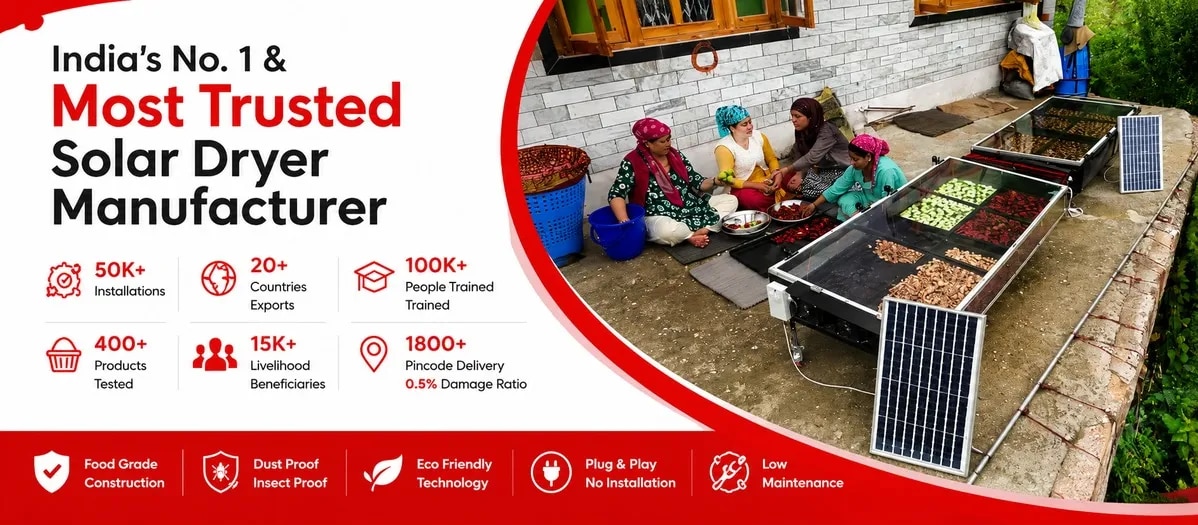
Rudra Solar Energy describes its solar dryer range as systems designed to dehydrate suitable produce using solar heat. The company offers cabinet dryers from 5 kg per batch to 500 kg per batch as well as larger commercial configurations.
Understanding Solar Dehydration
The word dehydration describes the removal of moisture from a product. In food and agricultural processing, the process needs to be controlled according to the material.Different products have different moisture levels, structures and preparation requirements. A thin slice of fruit behaves differently from a whole vegetable, grain or herb.
The Role of Heat
Solar radiation can provide heat for the drying process. The heated air interacts with the product and helps moisture move away from it.However, higher temperature alone is not the complete solution. Airflow and product loading also matter because moisture-laden air needs to move away from the product.
How an Enclosed Solar Dehydrator Works
An enclosed solar dehydrator generally consists of a drying chamber, product trays, solar heating components and an airflow arrangement. Depending on the design, heating may involve direct and indirect solar methods.Rudra Solar Energy's cabinet dryer uses tray-based loading and combines solar heat with organised airflow. Its published specifications describe direct and indirect solar heating and optional electric or biomass backup depending on configuration.
Why Airflow Is Important
As moisture leaves a product, the surrounding air becomes more humid. Continued moisture removal becomes easier when this humid air is moved away and replaced with drier air.This is why an effective solar dryer is designed around the interaction between temperature, airflow, product surface area and loading.
What Can Be Dried?
The exact application depends on the design and the commodity. Rudra Solar Energy lists solar drying applications for fruits, vegetables, spices, herbs, grains, pulses, oilseeds, seeds and flowers, among other products. :contentReference[oaicite:10]index=10Fruit Dehydration
Fruit can be processed into dried slices, pieces or other suitable forms. Preparation can influence the drying process, particularly when products are cut into different thicknesses.Vegetable Dehydration
Vegetables can also be suitable for solar dehydration. Depending on the commodity, preparation may involve washing, trimming, slicing or other processing steps.Herbs and Spices
Herbs and spices often require attention to aroma, colour and handling. A dedicated solar herb dryer or solar spice dryer can be evaluated according to the product and desired processing conditions.Why Businesses Consider Solar Dehydrators
One reason businesses consider solar drying equipment is the opportunity to use available solar heat rather than depending entirely on conventional thermal energy.Know More Rudra Solar Energy states that its solar dryers are designed to reduce dependence on LPG, diesel, electricity or other fuel-based drying methods where those energy sources are currently used.
The actual economic benefit depends on the application, operating frequency, capacity and conventional energy source being replaced.
Solar Drying Is Not Automatically More Profitable
Profitability depends on the entire business model. Equipment cost, raw materials, labour, packaging, transport, maintenance, market demand and selling price all matter.A solar dehydrator can be a processing tool, but it does not by itself guarantee a particular income or return.
Choosing a Solar Dehydrator
The first step is identifying the product. A business should then determine how much fresh material is available and how frequently it needs to be processed.A useful checklist includes:
- Type of product
- Fresh input quantity
- Initial moisture condition
- Desired final moisture condition
- Product size or slice thickness
- Required batch frequency
- Available solar exposure
- Installation area
- Electricity availability
- Need for backup heating
Rudra Solar Energy's location guidance recommends considering the product, quantity, moisture, season, installation space, electricity availability and future expansion when evaluating a solar dryer.
Small and Commercial Applications
A solar dehydrator can be considered for small product trials, rural processing units, SHGs and larger commercial businesses.Rudra's cabinet range is stated to cover 5 kg to 500 Solar Drying Machine kg per batch, while the company also lists a commercial solar tunnel dryer for larger continuous dehydration requirements.
Matching Capacity to Production
Selecting the largest possible machine is not necessarily the right strategy. A system should correspond to actual Click Here raw-material availability and production plans.A smaller operation can begin with an appropriate batch configuration, while a commercial processor may need higher throughput.
Maintaining Product Quality
Drying is only one part of processing. Quality also depends on raw-material selection, cleaning, preparation, tray hygiene, cooling, packaging and storage.The operator should maintain a consistent procedure and observe the product throughout the drying cycle.
Record Keeping
Recording product type, quantity, preparation method and process observations can help an operator compare batches and develop a more consistent workflow.This becomes especially useful when different commodities are processed throughout the year.
Conclusion
A solar dehydrator can provide an enclosed approach to moisture reduction for suitable food and agricultural products. It uses solar thermal energy while allowing the operator to manage product loading and airflow in a structured environment.Rudra Solar Energy offers solar drying systems for different scales and applications, including fruits, vegetables, herbs, spices and other agricultural products.
The right equipment should be selected after considering the product, moisture, capacity, preparation, site conditions and production schedule. Used as part of a complete processing workflow, solar dehydration can help businesses explore value-added agricultural processing while making practical use of solar energy.
 Report this wiki page